 What are the options for charging EVs – electric vehicles?
May 11, 2026
by Nils Deacon, Manager, Inspections and Rating Services
Insurance underwriters are asking how to handle charging equipment for EVs – electric vehicles, in various commercial and residential settings.
According to the International Energy Agency, IEA, electric vehicles are now a fixture in the US with approximately 6 million on the road. Furthermore, there are predictions that the total could go up to 30 million by 2030. National Renewable Energy Laboratory (NREL)
All these vehicles require charging, which is done primarily (about 80%) at residences. Department of Energy
Other important charging hubs are highway rest stops, gas stations, and what are now called EV Forecourts. These are large, dedicated charging sites that look like modern service stations, often including shops and cafes. NJ Dept. of Environmental Protection
Knowledge of the different types of charging hardware and capabilities is helpful to understand the issue.
There are 3 current levels of charging capability:
• Level 1 – All current EVs can be plugged into a standard residential 120-volt outlet using the charger cord provided with the vehicle. This level provides 3-5 miles of range per hour of charging, equating to about 35-50 miles of range for 12 hours of overnight charging.
• Level 2 – These chargers plug into a 240-volt or 208-volt outlet that draws the same level of energy as an electric stove or clothes dryer. This Level of chargers provide 15-50 miles of range per hour of charging. This type of outlet requires installation by a licensed electrician.
• The next level, DC Fast Chargers (DCFC), are also called quick chargers or superchargers. They offer the fastest charging speeds. DCFC require a 480-volt circuit and can be found at highway rest stops, shopping centers, and community charging hubs or Forecourts. There are 3 types of connectors that depend on the vehicle make and model. These chargers can fill empty batteries to at least 80% in 20-60 minutes. NJ Dept. of Environmental Protection
It should be noted that EV battery fires are very rare compared to internal combustion engine or ICE vehicles – about 20-60 times less, depending on the source. This is per miles driven, not units in the field. Fires related to charging EVs are even less, representing only 15-30% of EV fires.
DISCLAIMER: This information reflects the interpretation of MSO, Inc. with regard to NFPA Standards and Codes and other code sources. It does not represent these codes’ official position on the items discussed.
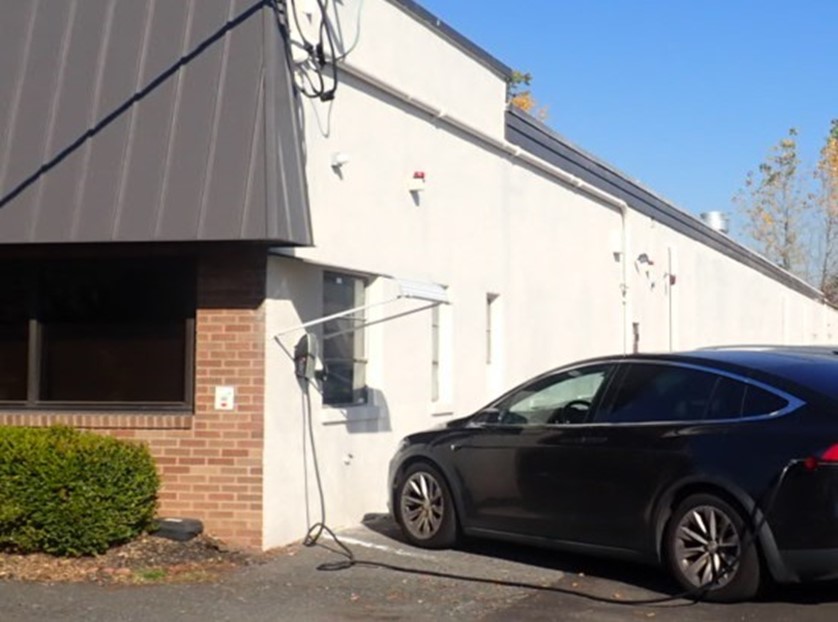
EV charger installed on a commercial building